std::copy的使用
看到有人在用std::copy这个东西,很简洁和爽啊,,所以找些帖子学习学习
http://blog.sina.com.cn/s/blog_8655aeca0100t6qe.html
https://www.so.com/s?q=std%3A%3Acopy%E5%87%BD%E6%95%B0&ie=utf-8&src=se7_newtab_new
copy函数的函数原型:

1 //fist [IN]: 要拷贝元素的首地址
2 //last [IN]:要拷贝元素的最后一个元素的下一个地址
3 //x [OUT] : 拷贝的目的地的首地址
4
5 template<class InIt, class OutIt>
6     OutIt copy(InIt first, InIt last, OutIt x);
如果要把一个序列(sequence)拷贝到一个容器(container)中去,通常用std::copy算法,代码如下:std::copy(start, end, std::back_inserter(container));
这里,start和end是输入序列(假设有N各元素)的迭代器(iterator)[例如start = iterator.begin(); end = iterator.end()],container是一个容器[例如vector],该容器的接口包含函数push_back。
假设container开始是空的,那么copy完毕后它就包含N个元素,并且顺序与原来队列中的元素顺序一样。标准库提供的back_inserter模板函数很方便,因为它为container返回一个back_insert_iterator迭代器,这样,复制的元素都被追加到container的末尾了。
现在假设container开始非空(例如:container必须在循环中反复被使用好几次)。那么,要达到原来的目标,必须先调用clear函数然后才能插入新序列。这会导致旧的元素对象被析构,新添加进来的被构造。不仅如此,container自身使用的动态内存也会被释放然后又创建,就像list,map,set的节点。某些vector的实现在调用clear的时候甚至会释放所有内存。
通常,考虑到在一个已有的元素上直接copy覆盖更高效。keyi这样做:
std::copy(start, end, container.begin());
在这里你在container的头部执行了copy-over(覆盖赋值)操作,但是,如果container的大小小于输入序列的长度N的话,这段代码会导致崩溃(crash)。
eg1: //可以使用copy给数组赋值啊!!! 但是要注意 sizeof(b) 必须大于 [(a+3) – (a)] 的长度
int a[3]={1,2,3};
int b[3];
std::copy(a,(a+3),b); ——>[a, a+3)
for(int j=0;j<3;j++)
cout<<b[j]
eg2:
vector<int> temp(3); //初始化一个有3个元素的vector
int a[3]={1,2,3};
std::copy(a,a+3,&temp.front()); // 或者是 std::copy(a, a+3, temp.begin())也可以
cout<<<endl;
for(int j=0;j < temp.size(); j++)
cout<<temp[j];
copy只负责复制,不负责申请空间,所以复制前必须有足够的空间
copy只负责复制,不负责申请空间,所以复制前必须有足够的空间
copy只负责复制,不负责申请空间,所以复制前必须有足够的空间
copy只负责复制,不负责申请空间,所以复制前必须有足够的空间
接下来,让我们来看看数组之间直接用for拷贝和用copy拷贝的效率比较 http://blog.csdn.net/zhouxuguang236/article/details/10834567
在C++编程中,经常会配到数据的拷贝,如数组之间元素的拷贝,一般的人可能都会用for循环逐个元素进行拷贝,在数据量不大的情况下还可以,如果数据量比较大,那么效率会比较地下。而STL中就提供了一个专门用来进行容器元素拷贝的函数copy
  1 #include<iostream>
  2 #include<vector>
  3 #include<sys/time.h>
  4 #include<time.h>
  5 #include<iosfwd>
  6 #include<algorithm>
  7 #include<stdio.h>
  8
  9 using namespace std;
 10
 11 const long SECOND_IN_NS = 10000000001;  //1second in nanoseconds
 12
 13 class Timer  //计算时间差的类
 14 {
 15     private:
 16     struct timespec m_start;
 17     struct timespec m_end;
 18     clockid_t m_clockId;
 19     public:
 20     Timer(){
 21         init(true, true);
 22     }
 23
 24     Timer(bool realTime){
 25         init(realTime, true);
 26     }
 27
 28     Timer(bool realTime, bool startImmediately){
 29         init(realTime, startImmediately);
 30     }
 31
 32     void init(bool realTime, bool startImmediately){
 33         if (realTime){
 34             //Real time
 35             m_clockId = CLOCK_REALTIME; // is not a system call
 36             //m_clockId = CLOCK_MONOTONIC_RAW; //is a system call
 37         }
 38         else{
 39             //Process CPU time across all CPU core (threads)
 40             m_clockId = CLOCK_PROCESS_CPUTIME_ID;
 41         }
 42         if (startImmediately){
 43             start();
 44         }
 45     }
 46
 47     void start(){
 48         clock_gettime(m_clockId, &m_start);
 49         m_end = m_start;
 50     }
 51
 52     void stop(){
 53         clock_gettime(m_clockId, &m_end);
 54     }
 55
 56     //return - the passed time between start and last stop in nanoseconds
 57     double getNseconds() const{
 58         return (m_end.tv_sec - m_start.tv_sec) * SECOND_IN_NS + (m_end.tv_nsec - m_start.tv_nsec);
 59     }
 60
 61     //return - the passed time between start and last stop in seconds
 62     double getSeconds() const{
 63         return (m_end.tv_sec - m_start.tv_sec) + double(m_end.tv_nsec - m_start.tv_nsec) / SECOND_IN_NS;
 64     }
 65
 66     //return - the passed seconds without need of stopping the execution
 67     double getSecondsAndContinue() const{
 68         struct timespec tempEnd;
 69         clock_gettime(m_clockId, &tempEnd);
 70         return (tempEnd.tv_sec - m_start.tv_sec) + double(tempEnd.tv_nsec - m_start.tv_nsec) / SECOND_IN_NS;
 71     }
 72
 73     time_t getS() const{
 74         time_t ret = m_end.tv_sec - m_start.tv_sec;
 75         if (m_end.tv_nsec < m_start.tv_nsec){
 76            ret -= 1;
 77         }
 78
 79         return ret;
 80     }
 81
 82     time_t getNs() const{
 83         if (m_end.tv_nsec >= m_start.tv_nsec){
 84             return m_end.tv_nsec - m_start.tv_nsec;
 85         }
 86         return SECOND_IN_NS + m_end.tv_nsec - m_start.tv_nsec;
 87     }
 88
 89     friend std::ostream& operator <<(std::ostream& os, const Timer& timer);
 90 };
 91
 92 std::ostream& operator <<(std::ostream& os, const Timer& timer){
 93     char nsBuf[10];  //999, 999, 999
 94     if (timer.m_end.tv_nsec >= timer.m_start.tv_nsec){
 95         os << timer.m_end.tv_nsec - timer.m_start.tv_sec;
 96         snprintf(nsBuf, sizeof(nsBuf), "%09li", timer.m_end.tv_nsec - timer.m_start.tv_nsec);
 97     }
 98     else{
 99         os << timer.m_end.tv_nsec - timer.m_start.tv_sec - 1;
100         snprintf(nsBuf, sizeof(nsBuf), "%09li", SECOND_IN_NS + timer.m_end.tv_nsec - timer.m_start.tv_nsec);
101     }
102     return os<<"."<<nsBuf;
103 }
104
105 void set(int& n){       //被for_each调用
106     static int value = 0;
107     n = value++;
108 }
109
110 void print(int n){      //被for_each调用
111     cout<<n<<endl;
112 }
113
114 int main(){
115     /*test short copy*/
116     vector<int> iVec(1000);
117     for_each(iVec.begin(), iVec.end(), set);
118     //for_each(iVec.begin(), iVec.end(), print);
119
120     int* pInt = new int[iVec.size()];
121
122     Timer timer;
123     copy(iVec.begin(), iVec.end(), pInt);
124     timer.stop();
125     cout<<"the short copy cost("<<timer.getSeconds()<<")'s"<<endl;
126
127     timer.start();
128     int size = iVec.size();
129     for (int i = 0; i < iVec.size(); i++)
130     {
131         pInt[i] = iVec[size - i - 1];
132     }
133     timer.stop();
134     cout<<"the short loop cost("<<timer.getSeconds()<<")'s"<<endl;
135    delete []pInt;
136     cout<<"---------------------------------------"<<endl;
137
138     /*test long copy*/
139     vector<int> iVec2(1000000);
140     for_each(iVec2.begin(), iVec2.end(), set);
141     //for_each(iVec.begin(), iVec.end(), print);
142
143     int* pInt2 = new int[iVec2.size()];
144
145     Timer timer2;
146     copy(iVec2.begin(), iVec2.end(), pInt2);
147     timer2.stop();
148     cout<<"the long copy cost("<<timer2.getSeconds()<<")'s"<<endl;
149
150     timer2.start();
151     int size2 = iVec2.size();
152     for (int i = 0; i < iVec2.size(); i++)
153     {
154         pInt2[i] = iVec2[size2 - i - 1];
155     }
156     timer2.stop();
157     cout<<"the long loop cost("<<timer2.getSeconds()<<")'s"<<endl;
158     delete []pInt2;
159     return 0;
160 }
编译命令: g++ -o test main.cpp -lrt
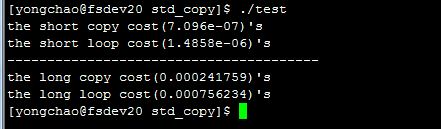
测试结果,跟作者的大相径庭,不知是和原因: